
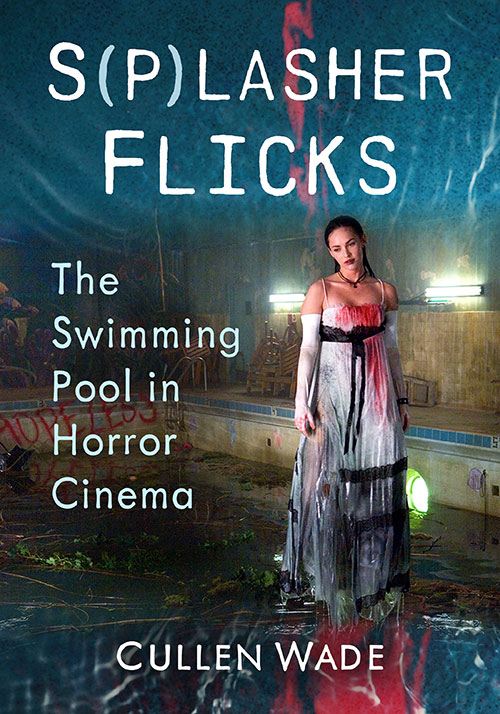
S(p)lasher Flicks: The Swimming Pool in Horror Cinema
McFarland & Company, Inc., Publishers (2025)
Reviewed by Christina Persaud
When most of us think of horror movies, rarely does the image of a swimming pool come to mind. We’re much more accustomed to fog-laden cemeteries and dilapidated haunted houses than the sunny disposition of a pool. So when I started reading Cullen Wade’s new nonfiction book, S(p)lasher Flicks: The Swimming Pool in Horror Cinema, I was surprised to see that there is, in fact, a place within the dark genre for the watery setting. And not just any place – but a significant one. If I counted correctly, S(p)lasher Flicks features approximately 102 references to horror films that feature a swimming pool, whether they’re located in a suburban backyard, a gymnasium, or a high-end vacation resort.
So why do so many horror movies feature a swimming pool? What significance does the setting have in a story? And, as audience members, are we potentially overlooking the swimming pool when it is so commonplace in horror cinema?
S(p)lasher Flicks: The Swimming Pool in Horror Cinema by Cullen Wade and published by McFarland is divided into three parts. The first discusses what the swimming pool means to us as human beings, as a species with primal fears, secrets, and layers, some of which are above the surface and others that are hidden in the depths below. The author does a wonderful job of explaining how reflections, danger, and knowing our true selves even when we may not want to can all be artistically and thematically conveyed through the use of swimming pools. “Water hides things, but so do people,” Wade writes when describing the way in which we push down shame and trauma. Films like House (1977) and A Nightmare on Elm Street (1984) show how emerging from a pool can represent “crossing the boundary between the characters and the truths of their pasts.” Other films like Burnt Offerings (1976) use the visual cue of the swimming pool to represent the uncomfortable truth that death is ultimately inescapable. From the smallest realizations to universal ones, the transparency of water leaves truths exposed, something the horror genre has long been known to do.
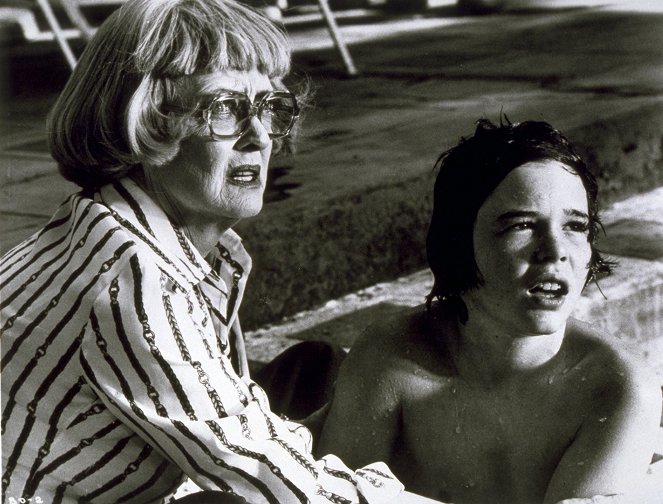
In parts two and three of the book, Wade dives into the pool as a class symbol, a cultural symbol, and one ingrained in the socio-economic fabric of American history. For instance, America’s dark chapter of segregation and its subsequent ripple effects are evidenced by access to swimming pools. “…Swimming pools in the U.S. have been fraught with social tension since at least the early 20th century.” (Wade, 2025) And sexuality and its symbolisms are described in thought-provoking detail through It Follows (2018), Jennifer’s Body (2009), Shivers (1975), Cat People (1942), and many other horror films that utilize the swimming pool. And analyzing the economy, Wade points out: “With housing anxiety so pervasive in the American psyche, and with such an apparent gulf between what we are told we can achieve and what is actually probably, for many people, the backyard swimming pool has taken on a darker connotation. Rather than aspiration, it can inspire resentment: a discretionary indulgence, a symbol of waste and extravagance for those insensitive to how much the average person must struggle simply to get by.” When it comes to testing the waters for imbalances, the swimming pool seems to have been an accurate indicator all along.
“The idea of vanquishing the monster in a swimming pool goes back almost to the birth of the teen horror film – as far back as 1962 with Arch Hall Sr.’s Eegah!” – S(p)lasher Flicks
S(p)lasher Flicks: The Swimming Pool in Horror Cinema opened my eyes to how impactful swimming pools can be in storytelling. Horror movies have historically used swimming pools as a tool to reflect ourselves and society. The true beauty of movies like Gremlins (1984), for example, is the way in which directors incorporate the setting without it being overtly obvious. Just like swimming pools being attached to places and structures, pools in horror movies aren’t often the focal point, but rather a highlight. The book even speaks on the future of the horror film, with Wade saying, “Horror cinema can show us where we’ve been and where we are, but it also has a habit of telling us where we’re going.” I won’t give away just what the author’s predictions are for upcoming trends in horror; however, given this impressively researched work and his fascination with swimming pools, I’d say Wade knows what he’s talking about. After all, he wrote, “This text is the product of a decade’s worth of thinking about what makes the swimming pool such a potent image in horror cinema.” It’s safe to say that swimming pools in horror films are not floating away any time soon.
I highly recommend S(p)lasher Flicks: The Swimming Pool in Horror Cinema by Cullen Wade for readers and moviegoers interested in horror storytelling. The nonfiction book’s themes of “secrets, gender, atavism, metamorphosis, segregation, the blurred line between the human and natural worlds,” among others, will draw you into the deep end. And chances are, you’ll never look at a pool in a horror movie the same way again.
S(p)lasher Flicks: The Swimming Pool in Horror Cinema is available everywhere books are sold.
Articlesofhorror.com is grateful to McFarland for providing a review copy of S(p)lasher Flicks: The Swimming Pool in Horror Cinema.
Cullen Wade is a writer, musician, and high school teacher from Charlottesville, Virginia. His film writing has appeared in Night Tide Magazine, online outlets like Horror Homeroom, HorrorGeekLife, Deaf Sparrow and Boy in a Box, and he has been a guest programmer and panelist at the Virginia Film Festival.