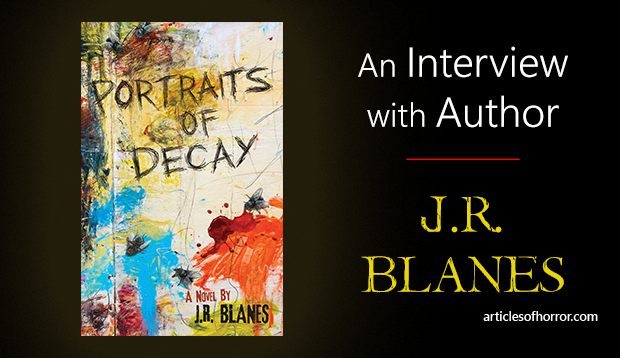
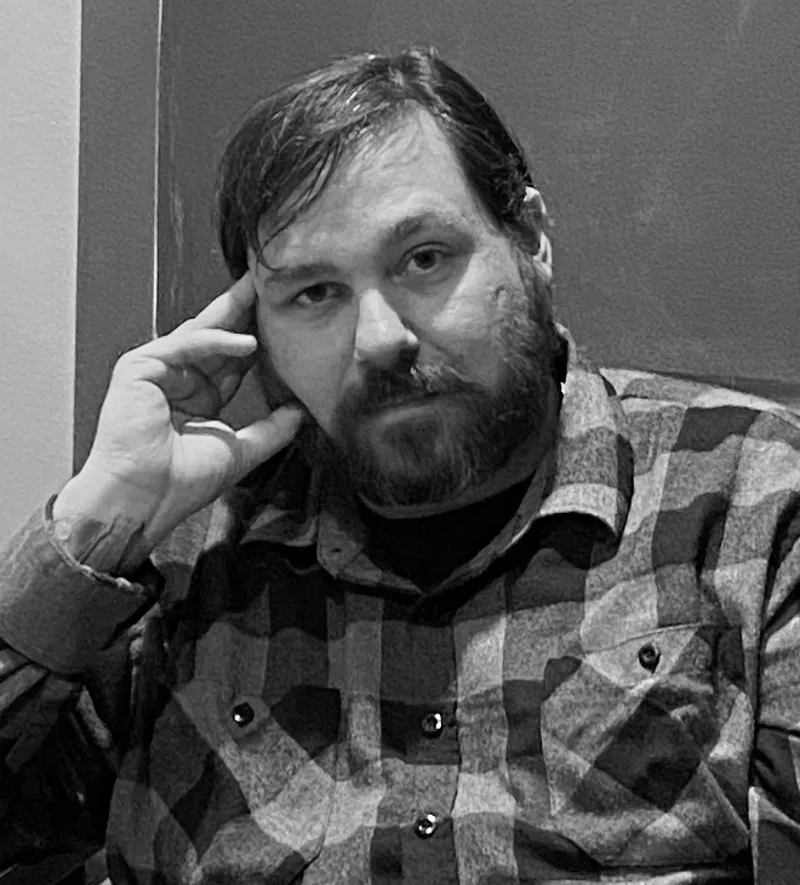
After being published in numerous magazines, anthologies, and podcasts, horror author J.R. Blanes devilishly delights as he steps into the spotlight with his debut novel.
The talented writer spoke with Articles of Horror to discuss his new book, Portraits of Decay, as well as his deep-rooted admiration for the city of New Orleans and his timeless love of the written word.
AH: Tell us a little about yourself and your writing career.
J.R. Blanes: My name is J.R. Blanes. I live in Chicago with my wife and our neurotic dog. When I’m not writing, I work for an immigration attorney. I’m a legal assistant, so I help people get their green cards and with naturalization, with asylum and things like that. I do my best to fight the good fight, I should say.
My writing career is a long one. I started writing as a kid and really loved it for a long time. Then I kind of got into music for a little while. I was actually a bass player in bands for quite a few years and then I got back into it in my late twenties and I kind of went through a lot of different things where I was trying a lot of different genres. I did some sci-fi for a while. I actually did a lot of literary stuff but horror was always my first love.
A couple of years ago, right around the pandemic, I decided I wanted to go back to writing horror. So, I started writing some short stories and kinda seeing where that led me and found that I really loved it and really wanted to pursue that. I published some stories in magazines and a few other places and then in about 2022, I started working on this novel. That’s the short version of my writing career. I’ve taken a lot of classes and been lucky enough to work with some other major writers like Richard Thomas and Ania Ahlborn and Gwendolyn Kiste. To have them kind of tutor me (Cynthia Pelayo was actually my mentor through the Horror Writers Association), getting to learn from them and having them look at my work and give me feedback was definitely very helpful, especially as far as learning the horror tropes and things that go along with the horror genre.
AH: Once you’re a lover of horror, it just seems to have a hold on you, like you were saying it did for you from a very young age.
J.R. Blanes: Yeah, as far as monsters, I was really into the Universal monsters. My father got me all the models and we built and painted them and I used to have them all on my shelf when I was a kid. And I don’t know how many people outside of Chicago know Son of Svengoolie (it’s kind of a comic showing movies). I used to watch them religiously as a kid. So those are my first introductions and then I started getting into Tales of the Crypt and Edgar Allan Poe and Lovecraft and that led to me finding Clive Barker and he became my favorite writer of all time. Thankfully my parents were very nice in letting me indulge in that. Maybe they were just happy that I was reading.
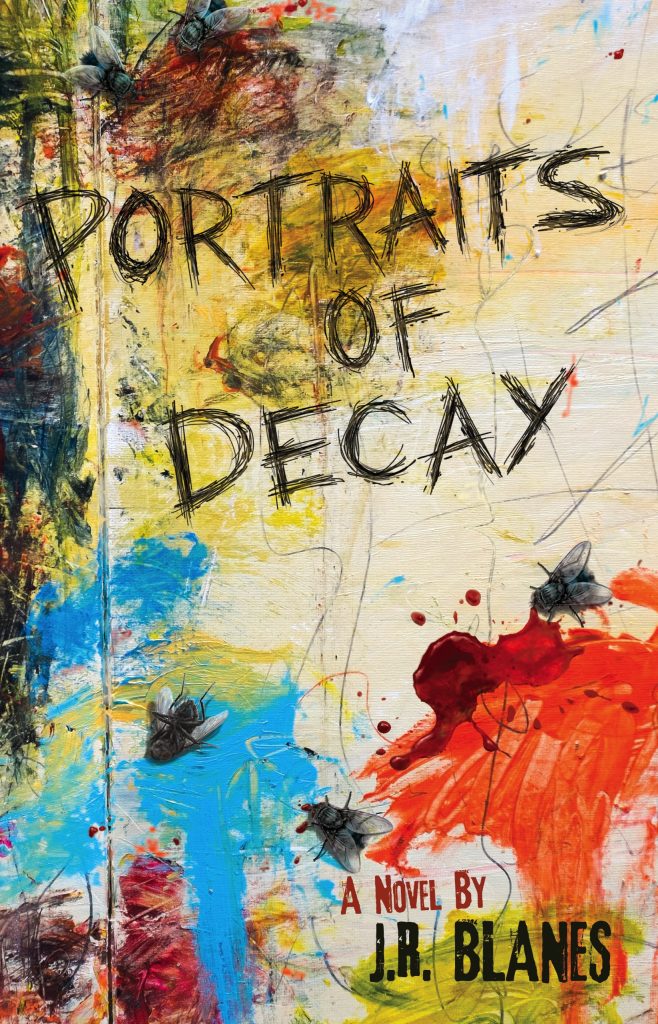
AH: Let’s talk about ‘Portraits of Decay’. You mentioned in the beginning of the book that the story is based on a short story you wrote.
J.R. Blanes: I really wanted to write a New Orleans story. I had spent a lot of time in New Orleans. I used to work for a railroad company, and I would go from Chicago to New Orleans every week. I would be in New Orleans for four days a week for about three years. So, I got to know the city really well. It kind of became my home away from home. I really wanted to write a New Orleans novel that had the folklore and the feel of the city. The original short story is chapter eleven [in “Portraits of Decay”]. It’s when Gemma goes to meet the witch. It was just about a woman who goes to a witch for a potion to put her boyfriend under a spell. Obviously, things go a little bit different for her in the novel because that was just a contained short story. I put it [the short story] away for a while, but I kept coming back to it. I knew there was something there. I was like, I think I want to expand on it.
Originally, it was just about a love triangle and as I began working on it, I felt I needed something more, something outside of just being in love and having people cheating on each other. That’s when I came up with [adding] the art because I feel like art is such a big thing to New Orleans. Obviously, you have the music, but you can’t walk down streets without seeing paintings. You have Jackson Square and Royal Street, and there’s just so much art everywhere. I think it’s such an important thing to that city and [its] identity. So, I thought, that’s what I’m going to go for and that was when the whole novel started to come together.
The way the short story came about was I was talking to a musician friend of mine and we were talking about what if you couldn’t make your art? What if you lost your hand and couldn’t play your guitar or couldn’t write? I think I would just wilt away because part of my identity is my art. My soul is in that. So, once we had that conversation, I started thinking a lot about [it] and I was like, I want to do something with this New Orleans story that I have. Because essentially if you give someone a potion that turns them into some sort of servant or zombie, their will is going to be taken away, their individuality. When I found the art storyline, I thought it would be perfect because then he [Jefferson] won’t be able to make the art he so desires to make.
AH: Also in the very beginning of the book, it says that you see yourself in the three main characters. I’m curious how?
J.R. Blanes: Let’s start with Gemma. Everyone looks at her and thinks that she’s a monster and she is in a certain way, but she’s also someone who saw something in Jefferson and saw someone who is special. So, if you look for any positives in Gemma, she did really take Jefferson under her wing because there was something about Jefferson that spoke to her. So, if I feel that if there’s something about me that’s part of Gemma, it’s that I always want to help my fellow artists. I never say that I really love [a] book if I don’t really love [a] book. I’m not the type of person who reviews books if I don’t like them. I only gush about books or art that I love. I always want to find a way to tell other people about them [artists], whether through word of mouth, or on social media. So, I think that if there’s a part of me that is part of Gemma, it’s that [if] I see something in [a] person, I really want to do something for them and for other people to see what I see.
I used to be, especially as a young man, [a] very non-confrontational person to my own detriment sometimes. I think I’ve hurt some friendships and relationships that way because I was afraid to tell people what was on my mind or what was bothering me because I wanted to just let it go. So, I feel like that part of me is what Jefferson is. Jefferson is someone who is trying to avoid confrontation, find a way for everyone involved [to] end up happy. But in the end, he ends up hurting [them].
Neveah would be someone who, for me, had to deal with some real hardships and took those hardships and made something out of it. I think that’s something almost everyone can relate to. Obviously, not all of us has had the abuse that she’s suffered, but I think everyone has had something that’s hurt them that they’ve had to overcome. In my case, anxiety would be one. Both of my parents have passed away at this point. My mom passed away when I was very young, and that was a very hard thing for me to deal with. How I dealt with it was through my art. So, I wanted to explore that in Nevaeh as someone who has suffered a very extreme hardship and she’s able to come out of it on the positive side by doing her art. For me, that was the part of Nevaeh that I really related to.
In that sense, I think I can relate to all three of the main characters, even though none of them is me at all. There’s obviously a lot of things I would never do that they did, but I can relate to them. I think almost all my characters, in some way, I can find something. I don’t think I would write them if I did not relate to them in some way or at least have some sympathy or passion for them, even the villains.
AH: The language of the characters in the book often mixes English with Creole and Cajun French. Was it difficult to write this unique blend of dialect?
J.R. Blanes: I did a lot of research on the dialects. I did some through reading but I also did a lot of it from being in New Orleans and talking to people who speak those dialects. Luckily I met a Cajan gentleman who was doing cemetery tours and I spoke to him a lot about it at that time. I would go to the local bars and [places]… The hardest one was Creole because not a lot of people speak that anymore. It’s very difficult to find people that speak that language. A lot of young people are not as interested in it and it’s just not used that commonly. I found that I had to spend a lot more time research [Creole] through books or online. Where Creole [appears in the book], I pray that I got it as correct as I possibly could because it was very difficult to find places to really learn what that language was like. What I did was watch a lot of YouTube videos of people who spoke it, I did a short class on Creole language which was more of an introduction (I didn’t have money to take the indulge in the whole thing), but I just wanted to get enough to sprinkle it in so you can get that feeling of being in New Orleans. And then the Yat language – that was something I definitely wanted to put in because that’s the slang [spoken] and people get it wrong quite a bit. That I got from just living in New Orleans.
I took a lot of notes which is also something I do a lot when I write because I tend to write about real places. I very rarely make up my own places. For some reason, I like doing that. For one, it gives me a reason to go to some of these places and hang out there. I just want to capture that feeling. New Orleans – writers often get it wrong so I really wanted to do my best to get it right and I was just determined to make sure I captured those languages and those dialects correctly.
AH: It’s about being respectful.
J.R. Blanes: I think as a writer you have the duty to do that as well because it’s real people, real languages, real traditions. Even with voodoo – I wanted to capture the different sides of voodoo and hoodoo. There’s a big difference. Voodoo is a religion. It’s not about the usual things we see in films with witchcraft and stuff like that.
AH: How did you become familiar with this complex religion?
J.R. Blanes: The voodoo shop that’s in the book is not a real place. It’s a mixture of a bunch of different places. I had gone to some of the ones [voodoo shops] that are more tourist-related, like Voodoo Authentica which [sells] more of what you think of voodoo as far as films go (the dolls, etc.), but they also have a religious aspect. The last time I was in New Orleans, they were having a voodoo festival which was amazing. I was so happy to be down there when that was happening. It was beautiful, they had music and dancing, and the priestesses were talking about the religion and what it is and giving the history of it, how it ended up in New Orleans. I also visited [another voodoo shop where] they’re more about the selling of the herbs and how that relates to the religion and what each herb is for and the spiritual side of it.
Then there is the voodoo temple which is the religious aspect of it. They don’t have any of the commercial[ism]. That is a very holy place, so you have to be very respectful when you’re there and they definitely want you to know what the religion is – like, we don’t cut up chickens and drink the blood and we don’t put curses on people. This is not what this is about. So, I just went to those places and spent a lot of time. For me, it was very interesting. I wanted to learn about it anyway. I’m always interested in those kinds of things, which is why I like to travel [to] places [to] see what they’re like when I’m writing stuff because I really want to know. Then you’re there, you get the smells and the feels and the energy that are in those places.
AH: Did you have reservations writing about voodoo? Were there any rules you had in place for yourself as a writer as an outside observer?
J.R. Blanes: I think for me it was just getting it as right as possible, and I think I always had reservations because I knew I was still writing a horror novel. I still knew I was going to use the voodoo potion that’s supposedly in Haiti and things like that so I knew I was going to use things that certain practitioners would not approve of because they’re tired of hearing about it or seeing it in film and books. So, I knew I was going to have to walk that line, and I was probably going to upset some people because it’s still a horror book and it’s still entertainment. But, in that sense, the best thing I could do was just be as respectful as possible, which is why I wanted those aspects in there.
I wanted the characters to be like, no we don’t do these things, this is a religion, we have spiritual guides that guide us to places, we are [not] here to put curses or hexes on anyone, that this is not witchcraft. I really wanted to make it clear what those aspects were. So, was I nervous? Yeah, of course I was nervous, but I think that I knew I really wanted to write this book and if I wasn’t going to go through with it, then it wasn’t going to happen.
For me, it was, how can I make this as respectful as possible? I tried to do that with everything from the voodoo to the dialects to the city itself and the way I presented it. Setting for me was very important to make it as real as possible outside of these supernatural lessons in the book.
AH: What is something you hope readers take away from reading “Portraits of Decay”?
J.R. Blanes: I think there’s a couple of things.
I always say – If you’ve been to New Orleans, you want to go back. If you’ve never been to New Orleans, you now really want to go. If you live in New Orleans, you feel like you’re home. I really wanted the city to be its own character in this book. That was really important to me. I want people to feel like I got that right. I love having people from New Orleans say, I love that you wrote the bayou, and can tell [I] had gone there.
Another thing I want people to take away is knowing what it is like to be an artist, especially if you’re not an artist. Having the respect to know how hard people work for that. Being an artist is not easy because there is not a lot of money to be made in it. You’re putting yourself out there for people to see, which can make you feel very vulnerable at times. Most artists I know are people who struggle, at least writers as far as I know, with connecting socially with people in certain ways. A lot of us tend to keep to ourselves. A lot of us are coming from places of pain. I wanted people to get that out of [the book], too.
I also think I wanted people to think about love and how positive and damaging it can be. How, when you’re with somebody, you need to respect them for who they are as a person and realize that you have to speak truth to them. You can’t hide things [from] them or lie because you’re just damaging that relationship, who you are as a person and who they are. I wanted people to look at all these different aspects that I was putting into this novel and think – I can relate to it, I can see it. Is there a lesson to learn from it? I don’t know, but I’m hoping people will take [from] it something more than – Oh, that was a really good story that had some really good gore in it. I want to write horror stories that have something beneath the surface. I’m not writing horror novels that are just there to scare you, even though it has aspects of that. I’m hoping there’s more that people are getting out of this novel. I’m hoping that people can relate to it, be scared by it, be intrigued by it, but that there’s something there and it’s not just about scaring or grossing [you] out.
AH: What can horror fans and readers expect to look forward to from you in the near future?
J.R. Blanes: I’m shopping my second novel currently, which is a novel that takes place in Hartford, Connecticut because most people don’t know that that’s where the first witch trial took place. I will say that it has to do with witchcraft and teaching. I used to be an English teacher, so it’s dark academia. I have some new short stories coming out this year in a couple different places, which can be found on my website – jrblanes.com.
To learn more about author J.R. Blanes, visit jrblanes.com, his publisher Ruedon Books. Find him on social media under the handle JRBlanes76. Portraits of Decay is available everywhere books are sold.
Articlesofhorror.com is grateful to Ruadán Books for providing a review copy of Portraits of Decay.
by Christina Persaud