
Stephanie E. Jensen is an multi-faceted journalist and author with a growing body of horror titles to her name. She has published a collection of short stories (Heartbeat and Other Tales of the Weird and Macabre, 2025), stand alone novels (The Howling of the Dead, 2021), as well as the Dissecting House series. Articles of Horror spoke with Jensen about her latest book, Acetamine, and the importance of women’s voices in horror.
AH: Stephanie, can you tell us a little bit about yourself?
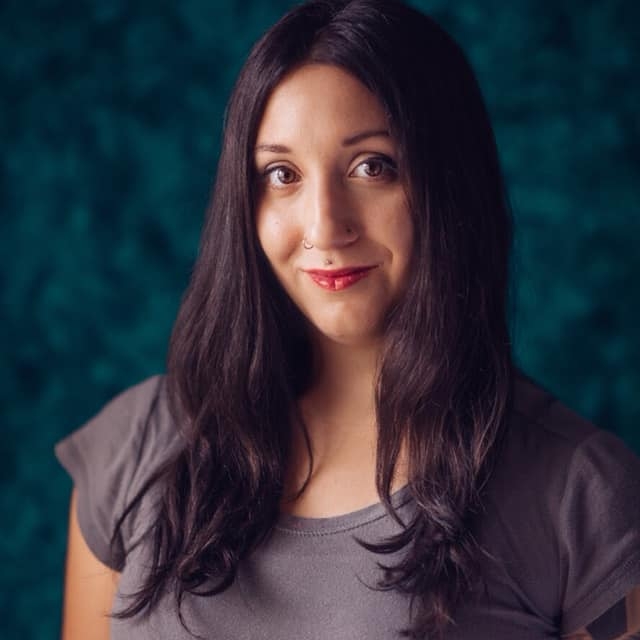
Jensen: My name is Stephanie E. Jensen and I’ve been writing since I was about seven years old. The majority of the books I’ve written are in the splatterpunk and extreme subgenres. I am starting to branch out a little bit, like with my newest book Acetamine [which] is more splatterpunk-crime. So, you get fun, gorey, crazy violence, but it’s not a traditional splatterpunk story.
…write some really grotesque stuff but write it beautifully.
AH: Who are some of your writing influences?
Jensen: Some of my earliest influences were R.L. Stine and Scary Stories to Tell in the Dark. Those books are still so dear to me today. I started reading Edgar Allan Poe when I was twelve. That’s when I started to get into “real” horror and the stuff that actually scared me. From there, I really fell in love with Laurell K. Hamilton. As far as splatter goes, Clive Barker, by far, is my biggest influence. Poppy Z. Brite, too. Those two authors [influenced me] to want to write some really grotesque stuff but write it beautifully. To tell a very good story, but also have it be disturbing.
AH: What draws you to the more violent side of horror?
Jensen: The fact that I’m a woman. Violence against women is very real. I’ve endured some stuff that I wish I hadn’t, and it was eye-opening . Opening up to the other women in my life, they mentioned that they had experienced similar, if not worse, things. I use my writing as a way to emphasize what I like to call “feminist splatter,” where I discuss misogyny and all the different ways women are discriminated against in society and using that as the backdrop for my splatter books.
I write about psychopathic women, such as Mina Bassey, a serial killer in my Dissecting House series. In Acetamine, I decided to change things up a little bit and the women are the victims of my main character, Dax. I’ve dug into themes from abortion and reproductive rights to early motherhood and ways women are discriminated against.
AH: What would you say to readers who assume that women cannot write believable serial killers or acts of violence? Or that they cannot write convincing horror in general?
Jensen: Who are the victims of crimes? Women. Not only cis, straight women, but trans women, people in the lgbtq+ community, brown and black women – we are the victims of crimes across all different severities. I see that, not only as a writer, but, more importantly, as a reader.
I would love to take a look at some of the books I did not finish reading because I guarantee they’ve all been written by white, straight men who have zero empathy for their characters. [They] reuse the same old horror tropes. Their writing and stories are very stale.
The majority of writers I read are women of all ethnic backgrounds and in the lgbtq+ communities. These communities have, unfortunately, real life experiences of violence, harassment, and discrimination that they can include in their stories. To me, [these stories] are a lot more thought-provoking. These writers have more empathy because they are able to construct more complex characters and create scenarios and worlds and plots that will leave you, as the reader, deep within the story, feeling exactly what those characters are going through.
AH: Let’s talk about your newest book, Acetamine. How did the idea come about?
Jensen: I had the idea when a friend of mine (who was unfortunately an on-again off-again heroine user) passed away from an overdose. I had been friends with her since we were teenagers. Her unfortunate passing really made me think about drug culture, the opioid crisis, and how all of this has (not only) really affected us societally but as a country and world. Also individually. [She] could be just another statistic, but to me she was a friend. I look back at so many cherished and fond memories and miss her dearly.
In Florida, new drugs are created and introduced for many reasons. Miami is a very popular port where drugs come into the state. Another thing I really emphasize in this book is how the heat [can] make us go crazy. Also, in general, we have a big party culture.
I wrote this book during the pandemic and the Black Lives Matter movement. I realized that my past books weren’t as diverse as they should have been so I was influenced to write about people of color and the [impact of] the war on drugs. I took the time to listen to my colleagues in these communities and apply their stories to my characters. My concern was always to tell these stories in the most authentic way possible.
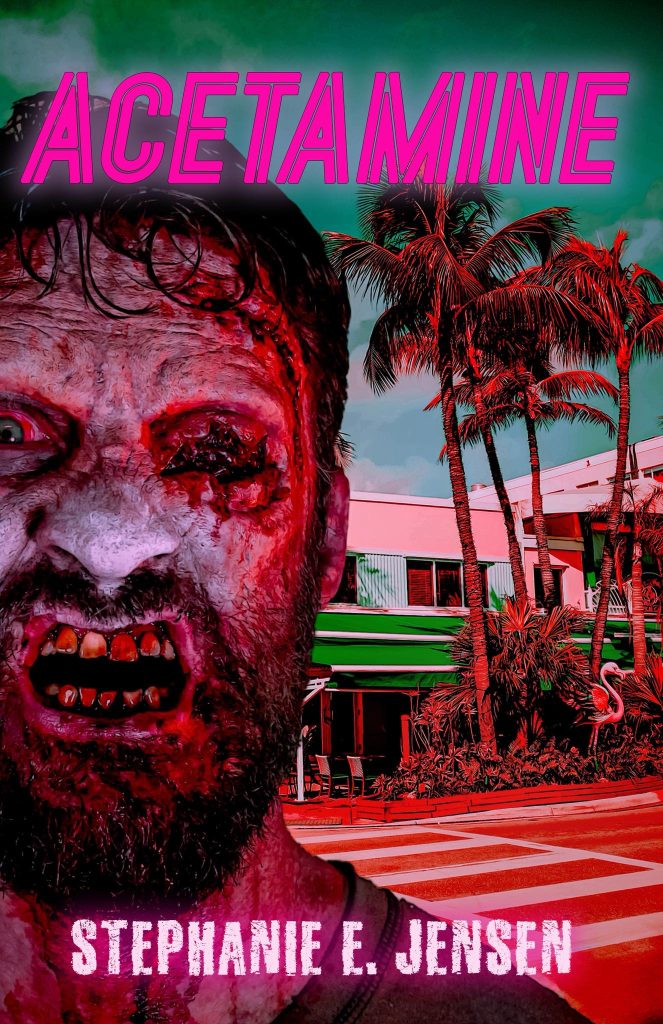
AH: In Acetamine, your main character, Dax, grows increasingly out-of-touch with reality. Does he symbolize Florida’s out-of-control development, gentrification, and growing disregard for its natural resources?
Jensen: I would say Acetamine, the drug itself, is what symbolizes that. The mass exodus of transplants moving to Florida got out of hand during the pandemic. [Places like Tampa, Florida] could not handle the sudden influx and it was chaos. In the book, [the character named] Ace creates Acetamine and it just blows up so quickly. It symbolized greed.
AH: I loved your description of certain places in Florida, especially Ybor City. Some might think this book is an insult to Florida as the main character, Dax, doesn’t seem to like his state, however you say it is more of a love letter. Can you elaborate?
Jensen: I think, specifically with Dax, he’s holding onto the very thing that makes Florida authentic, and that’s our nature, our parks, and our wildlife. Going back to greed, we watched developers attempt to build golf courses on our protected forests. We have a concentration camp in the Everglades. Not only is that a human rights concern, it is an environmental concern. I’ll never forget reading an article about a property developer attempting to build an apartment complex on [an area] of mangroves.
My love-hate relationship with Florida is I see what makes the state so special and unique, and I see that it is being taken away.
AH: What can readers expect to see from you next?
Jensen: I finished a book about grief horror that I am dedicating to my dad. I was invited to submit a splatterpunk short story that will center on religion to an anthology.
AH: Where can readers new and old find you?
Jensen: I have a website called infernalhorror.com. My books are on Amazon. If you are in the Tampa area, you can find my books at The Book Rescuers in Largo, The Paperback Exchange in New Port Richey, and Mojo Books & Records in Tampa. My Instagram is infernal_horror and I’m on TikTok at StephanieInfernal.